Saturday, February 28, 2015

UCI Formally Requests Astana’s License Withdrawal

Last July, Vincenzo Nibali won cycling’s biggest race. This year, he may not even be in the field.

That’s the possible result of news Friday morning that pro cycling’s governing body, the UCI, requested the withdrawal of the license granted last fall to defending Tour de France champion Vincenzo Nibali’s Astana team. 

The decision throws into question the future of the team; there are multiple scenarios, all of which are going to likely going to play out on a sped-up time frame, because the season is already a month old. Here are the basics:

What happened? 
The UCI requested that the “Pro Team” license for Astana should be withdrawn. That means it’s referred the matter to the UCI License Commission, an independent, four-person committee that rules each fall on teams’ license applications.

Why?
As a condition of Astana’s license approval last fall, the UCI ordered an independent audit of the team’s anti-doping culture and policies and management structure and systems. That audit, performed by the University of Lausanne’s well-regarded Institute of Sports Sciences, was delivered to the UCI recently. In a press release announcing the withdrawal request, the UCI said that that the “extensive report…contains compelling grounds to refer the matter to the Licence Commission and request the Astana Pro Team license be withdrawn.”

What’s the deal with the audit?
Last fall, the Astana team organization was hit with five doping positives: two for EPO on the main, Pro Team and three more, for steroids, on the developmental Astana Continental wing. The two teams are nominally separate but share some staff and management, most sponsors and are both organized as arms of the Kazakh Cycling Federation.

At the time, the team’s license was up for renewal. The License Commission approved its 2015 registration as a Pro Team, at the sport’s top level, but did so on several conditions, including that the team submit to the independent audit. 

Couldn’t they have done this sooner? The season’s already a month in and Astana’s won two races.
The License Commission made its decision in December and the audit started shortly after that. At the time the team got its license, UCI President Brian Cookson made little secret of his displeasure, but said he had to respect the UCI’s own rules, which clearly lay out that the License Commission, an independent body, has sole jurisidiction over the approvals. Cookson did add that Astana was “drinking in the last chance saloon” and made clear that any further screw-ups or discrepancies would cause the UCI to refer the matter back to the license commission.

OK, so what did Astana do now to warrant this?
The UCI hasn’t released the Lausanne report, and hasn’t even committed to doing so at any point. Aside from its press release, it says it will have no further comment until after the License commission decides. 

But in the press release, the UCI highlighted two significant points. First, it said the audit found “a big difference between the policies and structures that the team presented to the License Commission in December and the reality on the ground.”

In plain English, that suggests that the team essentially mis-represented itself in its presentation to the commission. If true, that alone could be grounds to revoke the license.

As well, the UCI noted that it had obtained from Italian authorities some evidence in the so-called Padova Investigation, an Italian criminal inquiry into sports doping that reportedly involved some members and staff of the Astana team. At the time of the initial License Commission ruling, the UCI was not in possession of those documents, so they couldn’t be factored in the commission’s decision. The UCI said it had passed those documents along to the License Commission. Any further revelations of involvement in doping by riders or staff would constitute a third positive, which is grounds for immediate revocation of a racing license.

What happens now?
The UCI didn’t release a timeline for a decision, but the License Commission will likely rule soon – within a couple of weeks. As noted above, the season is already a month old. The spring Classics season starts in earnest tomorrow and the UCI will be eager to resolve the issue quickly.

The License Commission has three general choices in front of it. It can deny the UCI’s request and allow the team to keep its license. It can revoke the first-division Pro Team license but allow the team to re-apply for a second-division Pro Continental license. Or it could revoke the license altogether, a kind of institutional death penalty.

In the last case and possibly the Pro Continental case, the team would be expected to appeal the decision to the Court of Arbitration for Sport, the highest authority for disputes in sports that are part of the Olympic movement.

CAS decision timelines are typically months, not weeks, but it will speed along particularly pressing cases. The only similar case in cycling was in 2013, when the UCI attempted to deny a top-level license to Katusha on somewhat similar grounds. Katusha won the case, which took roughly two months to decide.

What happens if Astana loses its license?
If the License Commission allows the team to apply for (and grants) a Pro Continental license, Astana could still race the 2015 season. But Pro Continental teams do not have true racing circuits of their own; they rely entirely on invitations from race promoters, especially to WorldTour events like the Tour de France.

Pro Conti status would force the team to appeal to the race organizers to extend an invitation, which might or might not be forthcoming. While most of the sport’s biggest races have already named wild card selections, it would not be difficult to add Astana since, for logistical purposes, the team had already been accounted for as a Pro Team.

However, Astana is not universally beloved in cycling. And particularly given the team’s struggles with ethics and doping, and its controversial manager, Alexandre Vinokourov, race organizers might well decide that they don’t want the possible negative attention that could come with the team’s presence.

If the commission completely revokes the license, then the team essentially folds, at least for the rest of 2015 until it could potentially apply again for 2016 (unlikely, but theoretically possible). That would put 30 riders and dozens of staff out of a job.

It’s worth noting that, under UCI rules, if a team loses its Pro Team license then all contracts are invalidated; riders would be free to seek other employment immediately. But that is a highly unlikely scenario.

Finding new teams at this stage would be almost impossible. Many teams are at UCI-mandated roster limits, and most are at budgetary limits as well. Even a rider like Nibali could be hard-pressed to find a team at this point in the season.

If we take the Katusha case as a guide, the end timeline for a CAS decision would be sometime in May. That could result in the second-worst timeframe possible, with a decision during the Giro d’Italia, where Astana’s Fabio Aru will be targeting overall victory. The only worse timeline? A decision just before or during the Tour de France. Hopefully this will be settled long before then, but there are, as they say, no guarantees.


  • Sexist Cycling Poster Fuels Outrage
post from sitemap

New Bike Route Mapped Along Northern Missouri's "Way of American Genius"

Walt Disney. Mark Twain. Newscaster Walter Cronkite. Retailer JC Penney. WWI General John "Blackjack" Pershing. Outlaw Jesse James. The Pony Express.  These people all have ties and connections to northern Missouri and a new bike route celebrates their contributions and influence, tying together a path taking cyclists among some of the most scenic and rural riding in the Midwest along with cultural experiences and historic sites that explore their contributions to American history.

Known as the "Way of American Genius" these famous Americans all come from towns along U.S. 36, a four-lane, divided highway that goes completely across northern Missouri. It connects Mark Twain's hometown of Hannibal, Mo., situated on the Mississippi River on the east side of the state with to St. Joseph on the west, where the Pony Express started and Jesse James met his end. Along the way, you'll find dozens of number of historic sites along the route that highlights the lives of these people and others and their contributions to American culture.

When the Missouri Department of Transportation developed an audio tour for motorist to listen to as they drove the Highway 36 corridor, I thought that a bike route along Highway 36 was a natural piece of this as well.  Bikers, either on short trips or extended tours, could enjoy the terrific riding offered by the quiet roads in the area as they explored the historic sites, state parks and other natural and cultural attractions along the way. So I approached the Missouri Highway 36 Heritage Alliance with the idea, and they were immediately on board.  These tourism boosters from cities in the region are keen to see more cyclists in their area.

Here are some of the cities along the way and highlights to be explored:

  • Hannibal: Mark Twain Boyhood Home and Museum
  • Bethel: Historic Bethel German colony
  • Macon: Long Branch Lake State Park
  • Marceline: Walt Disney Boyhood Home and Museum
  • Laclede: General John J. Pershing Boyhood Home State Historic Site
  • Sumner: "Maxie," the world's largest goose
  • Chillicothe: dozens of colorful murals showing the history of the city painted on downtown walls
  • Hamilton: JC Penney Museum; Missouri Star Quilt Company
  • St. Joseph: Jesse James Home, Pony Express National Museum, Walter Cronkite Memorial

Creating the a bike route was a fun experience for sure. Using Google maps and detailed maps provided by the state highway department with vehicle counts and other information, I aimed for low-traffic, high scenery state and county roads that paralled the main four lane highway and hit as many of the scenic attractions, historic sites, state parks, and charming little towns as possible along the way.

Once the route was complete on paper, we sought feedback from local cyclists and others who could give us feedback on the suitability of the routes we picked. Then we did a full-blown test ride  to get a first person look and to ensure the route followed the roads that were the best options for cyclists.  We took three days to cover the 260 miles, covering 80-90 miles a day.  You can click here to see a video on the ride that came from the local news station, which did live coverage of our arrival into St. Joseph.

The route continues to be promoted by the Missouri Highway 36 Heritage Alliance, and the group is optimistic that there will be increasing numbers of cyclists out on the road. In fact, a number of business in towns along the way are offering special rates and deals for cyclists.  Additionally the new route has received a lot of attention from regional and national cycling groups, and there is talk about its eventual inclusion in the U.S. Bike Route System, a national network of existing bike routes.

Highway 36 - Way of American Genius Bike Route website: maps, GPS link, local attractions guide, plus turn-by-turn directions.

post from sitemap

Friday, February 27, 2015

Review: Endura Hyperon Shorty Short

Endura Hyperon Shorty Short

Endura Hyperon Shorty Short

Ladies, I hope some of you can feel me on this.

Sometimes you’re out shopping, and you see a really cute dress. You try it on in the fitting room, and you think, “Gosh, that’s pretty short,” but then you turn around a few times more, walk out to see how it looks in the big mirror, and convince yourself it’s not too short. It’s short, but it’s tasteful. Really, you just like the way it makes your legs look hot. So you rationalize that you will most certainly find an occasion for which this dress is appropriate, and you buy it.

Then, you wear it out for the first time and spend the rest of your night pulling it down and strategically covering yourself up with your purse to avoid pulling a Britney any time you climb in and out of a taxi or bend down to fix your shoe. You might look kind of hot, but mostly you look uncomfortable. Because you realize there was a time in your life when you could’ve gotten away with wearing a dress this short, and it was called college. The dress gets relegated to the corner of the closet, next to the other too-short dresses you’ve bought in the past.

I pretty much did this exact thing last week, except I wore this dress to the office—but because I work at a bike magazine, instead of a dress it was a pair of Lycra shorts, and my office for the day was the winding, 9-mile climb up Figueroa Mountain outside Solvang, California, on Bicycling’s annual road bike testing trip. I was in the Endura Hyperon Short Shorts for the first time, and when I actually wore them on the bike, they proved to be shorter than I’d initially thought. “Those are some, uh, pretty short shorts,” my colleague remarked when he saw me adjust the Hyperon Short Shorts for the umpteenth time that afternoon.

They had looked awesome in the mirror when I first tried them on: The above-mid-thigh cut was flattering, making my legs look longer, and the seamless cuff meant there was no bunching or sausage-leg effect. They were, for lack of a better term, super cute. Of the several pairs of shorts I’d been sent to test this week, I’d been most excited about the Shorty Shorts after the private fashion show I’d staged in front of the mirror during packing.

But on the bike was a different story. That afternoon on the mountain they were, like me, riding up, up, up. When I was pedaling, the shorts rose up the leg an additional inch and a half or so—they were still long enough that my skin was never rubbing the saddle, but not long enough to prevent me from feeling a little self-conscious. Every time we pulled over and stopped, I’d immediately tug the hems back down my legs. The hot pink silicone leg grippers inside the leg bands were really cute—but I only noticed this because the seamless construction, while it made for an attractive fit, meant the edges of the shorts started to flip slightly inside out at the hem when I was pedaling for extended periods of time.

But the Shorty Short came through in the ways that mattered. I usually wear bibs, and I was surprised by how well the Shorty Shorts withstood the rigors of more than six hours of riding that day: a short, one-hour spin in the morning and our five-hour loop in the afternoon that included more than 5,000 feet of climbing and descending. The chamois stayed secure and kept me comfortable through it all. The built-in UPF50+ provided protection from the hot sun on the almost entirely exposed climb. The soft, wider waistband was comfortable and never chafed or rubbed. And when I looked at the photos afterwards, the shorts actually looked okay—enough that our photo director asked me to wear the same kit again for the next day’s shoot, because the Hyperons added some variety in a field of longer, black, bib-style bottoms. (Don’t worry, we did laundry.) Some credit definitely goes to the attractive, wind-blocking Endura Pro Jetstream jersey, too ($110)—I loved its form-fitting race cut and cool and classic white color, and silver zipper and accents that added some subtle but stylish bling.

Ultimately, the Endura Shorty Short will fare better than most of the too-short dresses I’ve bought in the past. I’ll wear them again—honestly, I’ll probably wear them a lot this summer. I just need another couple months or so to shed a few more winter pounds and build up a little more of a base tan. They’re some short shorts all right; but they really weren’t too short.

Price: $85
Info: endurasport.com


post from sitemap

How Aero is too Aero?

Jens Voigt

Using aerobars and dropping your torso toward your top tube shrinks your frontal surface area, making it easier to slip through the wind and go faster.

Aero is everything…until it’s not. On a flat road, aerodynamic drag is your biggest obstacle. You use about 80 percent of your power output to overcome wind resistance when you’re hammering down the road. Using aerobars and dropping your torso toward your top tube shrinks your frontal surface area, making it easier to slip through the wind and go faster. But as a new study points out, there’s a point of diminishing returns, because it’s harder to take full deep breaths and to push the pedals to produce maximum power when you’re all hunched over.

To show how dramatic an impact extreme aero positions can have on power output, a team of British researchers had 19 trained cyclists perform a series of power tests, starting at a 24-degree torso angle and dropping incrementally to zero (or as close as possible; not everyone could get that low). Every performance parameter tested, including efficiency, heart rate, cadence, V02 max, and peak power output worsened as the torso angle dropped. Power output fell 14 percent—51 watts—from the highest position to the lowest. Of course, the cyclists’ frontal area was also reduced (by up to 14 percent) as they got lower. So the riders would be more aero in real-world conditions. However, the researchers concluded the lowest position hindered performance so much that it should be avoided even by trained competitive cyclists. For the other positions, it’s a trade-off between how many watts you lose to impaired performance versus how many you gain in aerodynamic advantage.

“It’s pretty easy to test for yourself with a power meter,” says power-training guru Hunter Allen of Peaks Coaching Group. “But you can also test it by simply using speed and RPE [rating of perceived exertion].” Here’s what he recommends:

Establish a baseline. Find a nice flat section of road that you can ride uninterrupted. Cover up your computer so you can’t see your numbers. Then, using your normal position, do two out-and-back runs at an RPE of 6 on a 1 to 10 scale, with 10 being as hard as you can go. Check and record your average speed.

Test yourself. Lower your torso a few degrees. Again, without looking at your numbers, repeat the course at the same RPE. Check and record your average speed. Repeat the test (without wearing yourself out) in incrementally lower positions until your average speed slows down.

Stretch and train. Keep your position right at that breaking point for three weeks, riding at least three times a week, including one long ride on the weekend. During this time, stretch your hamstrings, glutes, calves, quads, and hip flexors daily.

Retest. After three weeks, go back out and retest yourself to see if you can now ride faster in that position. If yes, lower a bit more and see if you can go faster even lower. If not, bump your position back up to where you clocked your fastest average speed.


post from sitemap

Cannondale-Garmin Riders to Broadcast Live Workouts Via Peloton

If you’re a spin fanatic and haven’t heard of Peloton, you might be missing out. Peloton is a home-based spin class, complete with a state-of-the-art spin bike. For $1,999, you can purchase a completely adjustable spin bike with a screen that allows you to stream spin classes on-demand and display your metrics for an additional $39 a month.

Peloton has now launched a partnership with the Cannondale-Garmin pro cycling team to bring classes created and led by the riders to the Peloton platform. Alex Howes and Tom Danielson pioneered this program; both taught sold-out live training sessions in New York City in 2014. Since then, more than 2,000 people have accessed their classes from around the world via Peloton’s streaming program.

Some cyclists feel that spin classes aren’t for “real cyclists,” but Tom Danielson says that’s not true, especially when using the highly adjustable Peloton spin bike. “I think that it’s about getting your position correct. So if you’re a racer, this bike [Peloton’s spin bike] lets you really modify your seat height and stem length. It really enables a racer to get their fit right, so the bike feels the same as what they train on.”

The Cannondale-Garmin riders will create their own programs, so if Danielson is leading a workout, you know it’s going to be pro level. “My goal for everyone doing the class is to try and bring as many of the things I’ve learned in terms of training, the things I’ve enjoyed the most about cycling, and then also bring in some of my personality to the session.” Danielson says. “There’s a little bit of fat burning, fat and carb burning, carb burning, and all out anaerobic so that everyone gets a taste of each zone. And of course there’s the different pedal techniques, out [of the saddle], in [the saddle], front of the saddle, high and low cadence, and while we’re doing that we talk about the different muscle groups.”

An hour of hardcore sweating might seem like it would get boring, but when it’s as engaging as this, it flies by. “When I came up for the class, it seemed like an hour wasn’t even enough time. I did really short intervals, so a lot of it was three minutes on, three minutes off; four on, four off. It was so specific, and you were so mentally engaged, that before I knew it I was sort of cutting into my warm-up and cooldown to fit everything in. When it was time to end, everyone was like, 'oh my gosh, it's over,'” Danielson said.

Don’t worry about music options either; you won’t get stuck listening to some weird disco music. Danielson made sure he carefully selected the material. “I brought in all the stuff I listen to when I train. So I had hip hop, rock and roll, and electronic. I put everything together for the objective we were looking for. I put a song on that was exactly the length of the interval I wanted to do, so the tone of the interval matched the song.”


post from sitemap

Thursday, February 26, 2015

Scoresby PS launches Ride2School's ACTIVEMaps

Bicycle Network: Latest News

Scoresby Primary School students are riding, walking, skating and scooting into a healthier future thanks to the launch of Ride2School’s ACTIVEMaps, today.

Developed by Bicycle Network’s Ride2School program, ACTIVEMaps encourages school communities to adopt healthy habits by identifying suitable riding and walking routes to school.

Working in collaboration with Scoresby Primary School, all ACTIVEMaps routes begin within a ten minute travel-time zone of the school gate and include ‘part-way’ drop off points.

Attending the launch today, State member for Rowville, Kim Wells MP believes Ride2School’s ACTIVEMap initiative is a great way to encourage more students to get active while reducing traffic congestion at the school gate.

"Ride2School’s ACTIVEMap initiative is a great idea. I hope many children at Scoresby Primary will use the map to find the quickest way to walk or ride to school with their friends," Mr Wells said.

The launch proved a great success with more than 122 students getting active on their journey to school.

Scoresby Primary School Principal Matthew Coney is excited to work with Ride2School to build a healthier and more active school community.

“Here at Scoresby Primary School, we actively support initiatives that help students to increase their physical activity and we’re very excited to launch the maps at the beginning of the school year,” Mr Coney said.

Bicycle Network General Manager of Behaviour Change, Gemma McCrohan, added that encouraging students to actively travel to school boosts independence in a supportive environment and is a crucial part of their development.

“Students who ride or walk to school arrive energised, alert and more ready to learn than those who don’t,” Ms McCrohan said.

With the rising rate of inactivity levels in children, Ms McCrohan believes that Ride2School’s ACTIVEMaps initiative is a fun and engaging way to encourage students to get active in the lead up to National Ride2School Day on Friday 13 March, 2015.

post from sitemap

First Look: Bontrager’s Redesigned Aeolus D3 Carbon Wheel Line

Bontrager Aeolus Wheels

Bontrager has modernized its aero carbon Aeolus line of wheels, making them lighter, wider, tubeless-compatible, and disc brake-friendly. The Aeolus 3 (30mm), 5 (50mm), 7 (70mm), and 9 (90mm) will be offered in both TLR and tubular versions. All Aeolus models are wider now, measuring 27mm at the brake track and 19.5mm internally at the rim bed, for better support when used with increasingly popular wide tires. Impressively, Bontrager has also managed to trim up to 110 grams of weight from the D3 shaped aero carbon rim. The Aeolus 3 and 5 are also being offered in disc-specific models with Centerlock-style rotor compatibility and interchangeable axles for QR or thru-axle style dropouts to fit the ever-changing axle standards. Clydesdales take note: All of Bontrager’s wheels come without a weight limit.

Bontrager Aeolus Wheels

Claimed weights and prices:
Aeolus 3 Disc D3 Tubular: 1,150 grams; $2,400
Aeolus 3 TLR D3 Clincher: 1,356 grams; $2,850
Aeolus 3 TLR Disc D3 Clincher: 1,454 grams; $2,850
Aeolus 5 Disc D3 Tubular: 1,295 grams; $2,400
Aeolus 5 TLR D3 Clincher: 1,440 grams; $2,850
Aeolus 5 TLR Disc D3 Clincher: 1,558 grams; $2,850
Aeolus 7 TLR D3 Clincher: 1,608 grams; $3,000
Aeolus 9 TLR D3 Clincher: 1,812 grams; $3,000

Bontrager Aeolus Wheels


post from sitemap

Wednesday, February 25, 2015

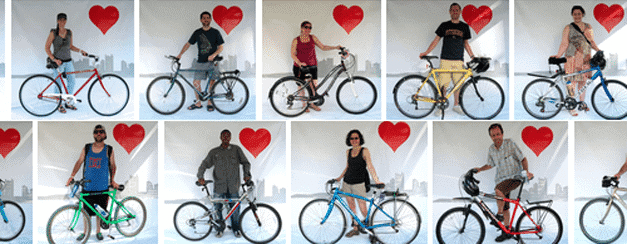
BikePGH! The 14 Types of Bicyclists We Love Newsletter Featured projects

14types
Spoiler: we love all of yinz. It’s truly a privilege to ride in this beautiful city with so many amazing people. #bikelove

1./ The Bike Commuter: You ride to your job as often as you can and love it. You can’t think of a better way to get to work.

2./ The $$ Saver: Money has always been tight and, for you, bicycling is the most practical way of getting around while staying within your budget. Cheaper than a car or a gym membership, biking just makes sense.

3./ The Weekend Warrior: You ride the roads or trails all weekend long. 50 miles is a short jaunt for you.

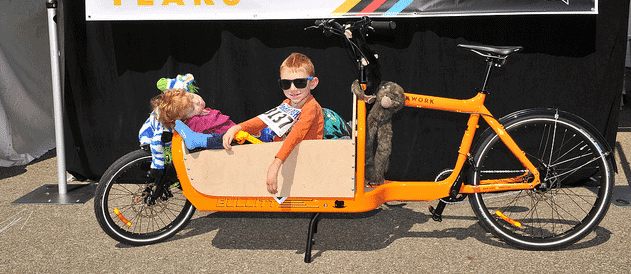
familybike
4./ The Family Rider: Nothing excites your family more than getting together for a ride. It’s a fun, healthy way to spend time together and an easy way to build fond memories.

5./ The Racer: You’re hopelessly devoted to training and putting in the miles. You know the roads inside and out because you’re out there all the damn time.

6./ The Advocate: 311 is on your speed dial, “I give bikes 4 feet” is on your bumper, “Share the Road” is tattooed on your calf, and you pedal your way to every public meeting. Speaking up for others navigating the city on two wheels is your passion.

7./ The Bike-Curious: You haven’t been on a bicycle in a few years but you’ve subscribed to the BikePGH email list, and have signed up for a City Cycling class. You’re pretty sure you’ll love bicycling and you’re getting ready to try.

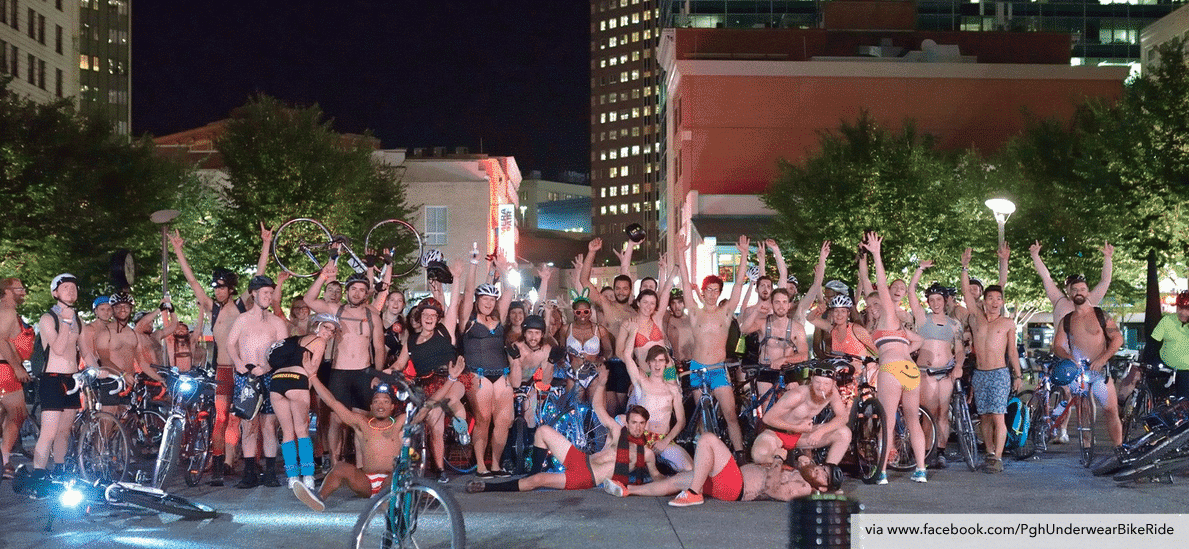
underwear
8./ The Social Biker: You’d never dream of biking to work, but you’ve never missed an Underwear Bike Ride or a Keg Ride. Your bike is a vehicle for having a good time and meeting new people.

9./ The Philanthropist: You use your bike as a vehicle for change, organizing rides to benefit medical research, food banks, homeless people, or social causes. You make it easy for others in the bicycling community to be kind, compassionate cyclists.

10./ The Tandem Riders: You two are inseparable on and off the bike. Go home. You’re too cute.

11./ The Environmentalist: Though ever-improving, Pittsburgh’s air still ranks in the dirtiest 13 percent of all U.S. cities. You ride because you like clean air. You know it’s one of the simple things that you can do to improve the air quality.

12./ The Multimodalist: You’ve never understood why some Pittsburgh riders complain about the hills. “That’s what the bike rack on the bus is for,” you say. You get around the city quickly and easily with your bike by your side and your Connect Card in hand.

13./ The Franken-bike Rider: You disappeared into your basement lair only to re-emerge with two bike frames welded together. You regularly gather your pals to ride your weird bikes en masse.

14./ The Person Who Carries Everything: You’ve got the handlebar coffee cup holder mounted over your pizza rack and, though you left your heavy-duty trailer at home for the day, your rear panniers are expertly filled to brimming.

BONUS
15./ The Mountain Biker: You steal away into the woods every chance you get and love riding our region’s fantastic trails in (like North Park and Frick park). For you, it’s simple: dirt + trees > concrete + asphalt.

Happy Valentine’s Day from Bike Pittsburgh. Which type(s) of rider are you?


Monthly Membership gifts

Introducing the monthly membership!
For the equivalent of a cup of coffee a month, your year-round support of our advocacy and programs makes our streets increasingly safer for everyone. You also get to choose from a set of great gifts when you start a monthly investment in better biking and walking in your community. Become a monthly member today!

post from sitemap

The Selection: Chamois In

Felvarrom Trouser Strap

I've fortified my passion for cycling this winter with viewings of Yowapeda, a Japanese anime series focused on Onoda-kun, an awkward but gifted young cyclist learning how [and why] to race. The series is great for beginners because the basics of riding are explained in a way that's clear and organic to the narrative. More experienced cyclists will enjoy the details and expression of the sensations of racing, which are overdramatized in anime-style with flashes of light, smoke, speed ripples, and screams, yet somehow still feel true to real life. Gary Fisher tells me an entire generation of Japanese riders is discovering and embracing the sport thanks to the series. You can watch it at crunchyroll.com.

yaowapeda


Today was the first time in a while that I had a day off from riding rather than one where I didn't get out for a ride—an important and telling difference.


I don't mind the pros, but I'm more interested in how my friends are riding. And I get my inspiration these days from people like Lindsay Knight.


Though the high-rolled cuff seems to me an admirable fusion of simple utility and effortless style, I resort to using a strap to keep my pants out of the drivetrain when the temp gets cold. My new favorite: the $23 Felvarrom Trouser Strip, handmade in Budapest from upcycled tires and tough, colorful fabric borders.


Chamois in. When it comes to the supposed rules of how to be a cyclist, I've ended up being a relativist: Probably. And only sort of. Unless you make something else work. But when we strip off then hang, drop, or store postride bibs anywhere anyone might in any way see, touch, or smell them, we are bound by decorum, empathy, and our awareness of the aesthetic and bacterial battleground that is the modern world to make sure to orient them with the chamois inside. It's true that inside out helps the pad dry quicker, but the welfare of all should not be sacrificed for the convenience of one. Plus: ick.


post from sitemap

Tuesday, February 24, 2015

Ridden and Reviewed: Diadora Vortex Pro Road Shoe

Diadora Vortex Pro Road Cycling Shoe

The stiff carbon-fiber sole on Diadora's top-tier cycling shoe, the Vortex Pro, is tough. So tough, in fact, that it withstood the rigors of my most recent adventure: an I'm-not-really-lost-I'm-just-exploring hike-a-bike up a dry streambed on a California mountainside.

But of course, the Vortex is a road-cycling shoe—which was proven by how well it performed on pavement, too.

The ventilation in the sole and perforated upper is effective, keeping my feet cool in warm, sunny conditions. The sole's mesh-covered venting holes held up when I had to dismount and shoulder my bike while negotiating that streambed and some steep unmaintained dirt roads. That was a bonus, because the shoe performed exactly as advertised on the road. The still sole delivering power and the Boa closure system snugging the shoe comfortably to my foot, even on a climb that had me nearly dragging my bike behind me.

The toe box of the Vortex is slightly pointed, and at first I thought my toes were hitting the end of the shoe. This was not the case; I was just not yet used to the shape, and it eventually conformed to my foot. Just a few miles after putting them on and rolling out, I had totally forgotten about their fit, and enjoyed how they helped me feel connected to my bike. One of the shoe's most notable features is a special material lining the heel cup that Diadora calls Suprell-Tech. It works just a little rough, like a cat's tongue, and has unidirectional fibers that act as a no-slip surface so that your foot stays put in the shoe. I never noticed this when I put the shoe on, but when I pulled up on the pedals, the Vortex stayed stuck to my heel without slipping. 

After many miles, the Vortex still feels like it conforms to my foot, and helps me stay connected to my bike. It

Weight: 269g (claimed)
Sizes: 37-47 (tested size 46)
Price: $379
Info: diadora.com


post from sitemap

Sexist Cycling Poster Fuels Outrage

E3 Harelbeke

Sexism and sport unfortunately have a tendency to be linked. Cycling isn’t any different. Remember that time Peter Sagan pinched a podium girl’s butt at the Tour of Flanders? Apparently, this is behavior worthy of attracting spectators to your event—at least for E3’s Harelbeke race. The promoters released a poster for the race featuring a cyclist's hand inching toward a woman’s bum. The slogan, loosely translated is, “Who squeezes them at Harelbeke?" I’ll pause here for a collective groan.

This isn’t the first incredibly sexist (and bizarre) ad that the race organizers have come up with: Some of you may remember last year’s poster, which featured three women posing as a bike, with another one riding it.

E3 Harelbeke

At best, the new poster's nod to what many saw as incredibly offensive behavior promotes the idea that cycling is a boy’s club, and at worst, it implies that cyclists are entitled to grope podium presenters. (Perhaps we should do away with the antiquated 'podium girl’ position altogether, and see if Sagan would make a grab for, say, UCI President Brian Cookson’s bum as he presents the awards.)

It’s perfectly possible that the race organizers deliberately chose such a sexist poster with the hope that the cycling community would rebel against it—thereby advertising its race and proving that all press is good press, which i


post from sitemap

Review: Magellan Cyclo 505 GPS device for Cyclists

About.com Rating

Cyclists can use GPS devices for several different purposes. Some riders focus on tracking their progress and performance both in real time as well as for later review.  Others use GPS devices like automobile drivers commonly do: as a source for way-finding directions on how to get to a specific location.

In terms of overall sales, Garmin pretty much has the edge in the U.S. market, at least and its Edge series of GPS devices are the leaders in the field.  However, Magellan with its competitively priced and easy to use 505 Cyclo GPS Cyclocomputer offers a decent alternative that will appeal to many riders.

We had the opportunity to try out the Magellan 505 GPS Cyclocomputer over the past several months. Our experience included a multi-day touring ride as well as mountain biking and road riding.  There are many features you'd expect, and some that you may not have known about but will relish nonetheless.

Basic Functionality

The Magellan 505 is envisioned as a handlebar mounted, readily visible and accessible tool fully operational by fingertip alone.  A 3" color screen is activated with a swipe anywhere, and is readable even in direct sunlight. A simple menu with large control buttons is easy to use, even with gloved hands.

The device features both direct and wireless connectivity to upload and download routes to the Magellancyclo.com website via your computer. Additionally, Bluetooth connectivity can link the Magellan 505 directly to your phone, giving you the ability to control music and notify you of incoming calls and texts. The device even offers an autoresponse option to advise those reaching out to you that you're on the bike, in case you want to share news of your good fortune (a day spent outdoors!) with others.

Additional linking capability offers compatibility with Shimano Di2 electronic shifting systems, reading and recording shifting information for review and feedback. Plus the Cyclo 505 work with more than 130 ANT+ accessories, such as heart rate monitors, and speed and cadence sensors.

Recording Activity

Magellan 505 offers realtime feedback on a cleanly laid-out, easily readable and fully configurable dashboard screen with the items you'd expect plus a number of other pieces of data, all accessed by a finger swiping through several different side-by-side screens.  These items include current speed, average speed, active time, distance, elevation, heart rate (displays when device has been paired with a HR monitor), total climbing, % grade, max speed, calories expended, distance to next turn (when in directional mode) and a map showing current position.

These can be utilized during a ride simply to monitor current performance, or tracked in recording mode for review and post-ride enjoyment. The Magellan 505 will ultimately provide a person with details like this, which came from a mountain bike ride I did last month.  Note distance, duration, calories burned, feet climbed, average speed, max speed and a map of my actual route.  A route can then be downloaded as a GPX file and shared with others or directly transferred wirelessly from one Magellan 505 to another and in both cases used in the future as a route with turn-by-turn directions.

The Magellan 505 can also be used to create an indoor cycling profile that you use on the stationary trainer when paired with appropriate ANT+ devices, giving you all the same data as an outdoor ride minus the GPS details.

Using the Magellan 505 for Turn-by-Turn Route Directions

I love creating routes for bike rides, and riding in new places. One of the best features of the Magellan 505 is its functionality in taking bike routes -- either self-designed or created by others -- and uploading these routes (called "tracks in Magellan lingo) to the device. Presto.  One has now turn-by-turn directions mounted on your handlebars with audio and visual indicators of upcoming turns. You want to ride from Chicago to the Bonnaroo music festival in Tennessee?  It's there on the site.  Plug it into the device and you have 646 miles of turn-by-turn directions from start to finish.

There's even a "Surprise Me" option, where if you just want to ride and don't have a destination already in mind, you can ask the device to suggestion some choices based on distance.  It will present you with three options, including notes on the amount of climbing in each. Just jump on your bike and go. Six different rider profile options allow you to select the types of roads you prefer -- quiet roads, bike paths, more busy streets, etc., and the suggestions will be calibrated accordingly.

Summary

There are so many terrific features in the Magellan 505 GPS Cyclocomputer that just to use it as a simple device for measuring speed/time/distance would be a shameful waste of its many other powerful capabilities.  Its ability to quickly and easily up- and download ride data and routes is a wonderful tool for touring and long-distance cyclists who don't have many other options for figuring out directions in unfamiliar territory.

Battery life is adequate at 12 hours, but actual consumption rate depends on specific features being used, i.e., turn-by-turn directions with screen constantly on vs. just monitoring in a more passive mode.

With pricing around $450-$500 the Magellan 505 Cyclo GPS is very comparable in price with the higher end devices in the Garmin Edge line, its most comparable option on the market today. This price point generally may be beyond what the more casual cyclist is willing to spend, but for the serious rider, either someone who is all about monitoring or measuring performance, or else the distance rider, such as a touring cyclist or a person frequently riding in new territory, this will be a great addition to your cycling inventory.

Disclosure: Review samples were provided by the manufacturer. For more information, please see our Ethics Policy.

post from sitemap

Product Review: Planet Bike Superflash Rechargeable USB Tail Light

About.com Rating

Bike lights, especially the red blinky light mounted on the rear, seem like the no-brainer bike accessory.  They're only about as complicated to operate as your bike spokes, right?  Put one on and off you go.  Well, if that's true, then how come so many people ride without lights during dawn/dusk/night? Don't they know the value of illumination oneself in order to be seen by others when out on the streets?  And why, even when a person does have one on their bike, does it seem like half the time we're all fiddling with a battery that has gone dead or a light that has simply gone kaputt.

Fortunately Planet Bike -- already known for a broad line of bike accessories -- has the answer to all these problems in its solid Superflash tail light, producing a red rear light for one's bike that is really as good as they come on the market today.

The original Planet Bike Superflash light has been on the market for a couple years, retailing for around $25 bucks.  That price may put it on the higher end of the pricing spectrum, but I have seen first hand that the quality and rugged construction of the light make it worth the money. I am a year-round bike commuter, and have been using the Superflash in all weather riding for the past 3-4 years. It has performed brilliantly, outlasting 4-5 other cheapie lights that cost $8-$10 each.  Especially impressive is how it has held up so very well, especially given the number of times that I have dropped the light on the tile floor of the locker room at work and the cement floor of my garage at home.

Planet Bike has recently released an addition to the Superflash line, the rechargeable Superflash USB. This combines the power and durability of the original along with a built-in Lithium Ion rechargeable battery.  Almost as simple to use as a dynamo-driven headlight, the Superflash USB (approximately $35 retail) uses a  USB cord to plug into a computer for charging. A short 2-4 hour charge produces up to 36 hours of run time, an eternity on a bike. For my 30-min daily commute, that's at least two months of riding between charges.

There are many things to like about the Superflash and Superflash USB.  While there are several different red blinky lights out there for sale with seventeen or more different flashing patterns, the Superflash offers delightful simplicity with just three settings: on, flash and off.  Plus - and most importantly - the light is BRIGHT.  When using the Superflash myself, and also while riding with others that have the light mounted, I noticed a couple things.  First it is nearly impossible to ignore the bright flashing light, especially when angled (heh heh) to shine directly into the motorists' line of vision as they approach from the rear.  Next, because the light is both bright and concentrated, it is visible from a long distance away.  No kidding, I can tell motorists are picking up the bright red blinking of the Superflash from a quarter mile away as they approach.

As far as any negatives, the one thing that I've found is that sometimes the on/off/flash button on the bottom of the light that cycles the Superflash through the settings is difficult to locate. A person can fumble around a bit trying to find the switch, but that's ultimately not a big deal.  Like anything, the more one uses the light, the more familiar the device becomes and locating the button quickly becomes easier.

All in all, the Superflash and Superflash USB come highly recommended. Each comes with a couple different bike mounts and a clip mount for multiple mounting options and quick on/off of one's bike.  Be aware that the Superflash USB doesn't come with a charging cord, but it's the ubiquitous thin charging cord used to throw juice into a variety of electronic devices, and chances are that you've already got a couple in a drawer at home.

post from sitemap

Troubleshooting Your Bike Computer When It Doesn't Work

There are several reasons why a cyclocomputer (sometimes called a velocomputer, a speedometer or bike computer) may not work.  The first and most obvious thing is that the battery is running low or actually drained. This is normally the case if the screen is blank or the numbers are very faint.  If this seems to be the case, take the bike computer off of its mount, turn it over and remove the battery cover with a coin. These are the so-called "button" batteries that you've probably seen before in many small electronic gadgets. Extract the old battery and buy a replacement. These batteries are readily available in watch shops, convenience stores or online.  If the device is revived after replacing the battery, simply follow the manufacturer's instructions to reprogram the device as needed.

If you are having problems where the display numbers are strong and vivid but the unit is constantly resetting itself, that is a typically signs of a problem with the battery's connections. Open the case as described above and use a clean cloth to wipe off the contact points inside the unit where the battery connects. If the bike computer got wet (as in really soaked, more than just an ordinary rain shower will do), that can cause similar problems.  In that case, leave the battery lid off so the unit can dry out for a day or two. After you've done this, reinsert the battery in its case and see what happens. You should find that the numbers on the display still showing vividly and now the problem with the unit resetting itself to be solved.

post from sitemap

Paracord: a worthwhile accessory for cyclists in case of problems

When you're a cyclist, one of the things you're bound to encounter is a situation where you find yourself trying to improvise repairs for your bike while out on the road just so you can get back home.  Maybe it is stitching up a big split in the sidewall of your tire or else stuffing a dollar bill or energy bar wrapper in there until you can do a more permanent fix. 

So, it's key to take a few key items with you when you ride to help address the most common fix-it situations you'll encounter. These are things like a spare tube; a multi-tool; a patch kit, etc.

Recently I came across another piece of gear worth considering for these types of situations. This is the Survival Straps wrist band, which is essentially a tightly wound length (approx 10 feet) of military spec woven nylon parachute cord that goes on your wrist like a bracelet. You've probably seen them before worn as a fashion statement, but I have to confess that until now I never fully understood the total potential for their use. When needed, it gets unwound and offers a handy option to bail you out of whatever situation you're in.

For instance, the paracord can be handy for any number of bike repairs (think of lashing on a pannier with a broken bracket; tying a broken spoke to another until you have opportunity to do a more permanent repair; or even serving as a temporary link in a broken chain). When riding cross country, It can also be used to tie on a sleeping bag or to secure other items that you acquire along the way but didn't necessarily plan for in your original bike tour packing list.  Plus the company promises that if you do use it in an emergency situation, they'll send you a new one, free of charge.  And that kind of deal almost makes one hope for a mishap, ha ha.

Other uses for paracord include application in a first aid situation, including as a method of lashing on splints to help shore up a broken bone; to help make an improvised sling; or God forbid, as a tourniquet in case of bleeding so severe that a person's life is at risk.

Another option for bringing paracord along instead of wearing it like a bracelet is to wrap your handlebars with it in place of bar tape.  It offers a cool look and different texture, plus makes a whole bunch more available to you when needed.  Here is a nice set of instructions on how to go about doing that.  Note that you'll end up carrying 20-25 feet (at least) of paracord.  That's enough to use to construct an emergency shelter if needed when you're out on a bikepacking trip.  You can stretch the cord between two trees and then use brush or ponchos or plastic tarps to create a tent that will keep you warm and dry.

So all in all, there are a ton of uses for parachute cord.  Enough so that it's certainly worth taking with you.  If you're interested in the Survival Straps wristbands specifically, check out the company's website here.  Otherwise you can find paracord in camping supply stores, military surplus or even on Amazon.  Prices are all over the place but generally in the range of $5.00 for ten feet, going on up to $20-30 for 200 feet.

post from sitemap

Mojo Refuel Aqua Battery Case - Protects and Recharges Your iPhone

About.com Rating

For a cyclist, a cell phone is almost one of those essential items to have along on every ride.  But when you carry it with you on the bike, there's also a strong need to keep that phone protected -- from shock (i.e., dropping it) or moisture, such as rain or perspiration.  There is also the fact that a phone's battery can run low, particularly if you're using it for GPS or mapping function on a longer ride, such as a 100-mile "century" ride.  

We had the opportunity to test the Mojo Refuel Aqua Battery Case, a phone case specifically for the iPhone 5 and 5s.  The manufacturer, ibattz, touts the case as having several revolutionary facets of design and performance. It offers:

  • "world's first" waterproof iPhone case with built in battery for recharging your phone
  • interchangeable 2200mAh battery
  • 100% protection from dirt, snow, drops, etc.

In looking at this, the first thing to note is that this Mojo Refuel Aqua Battery Case actually has a couple configurations.  Both use the back of the phone case for mounting, which is what contains the battery that provides back-up power to your phone.

In its full water-proof configuration, the phone case incorporates a plastic face with clear screen that goes over the phone and clicks into the battery pack on the back of the case. Then a rubber outer skin encases the phone from the back, forming a seal with the front face.  We tested this waterproof set-up (as recommended in the directions) to make sure that it would indeed keep the phone dry.  15 minutes underwater in the kitchen sink and the inside of the case was dry as a desert.  That's an impressive feat and the product documentation indicates this waterproofing is good to 3 meters. Think about it: you can take your phone with you on your bike in the rain, or have it with you poolside without the worry of what in the world you're going to do if it hits the water.

Now the downside. To keep the phone protected, naturally it's got to be sealed pretty tight.  And that affects the audio quality -- both in your ability to hear others and in the way you sound to them. So if you have a phone that you'll need to talk regularly on and with clarity, the waterproof option may cause you some dissatisfaction.  Also, we found that the sensitivity on the bottom part of the screen to user touch is compromised.  The phone did not always respond to the sideways swipe and other touch functions toward the bottom of the screen needed to operate the phone effectively.

In it's "light" (non-waterproof) configuration -- what you get if you buy just the Mojo Refuel case, the clear plastic screen and the rubber outer shell are set aside, and the phone merely has a silver plastic frame (or "bumper," as ibattz, the manufacturer calls it) attached to the back and mounted over the face of the phone like a typical phone case. Certainly in this setting the waterproofing is gone and a good deal of the shock protection is as well, but the upside is that you have the full functionality of the iPhone touch screen.

Apart from the waterproof features of the Refuel Aqua case, the back-up battery power that it provides is pretty cool in its own right, essentially doubling the useful life of your phone. Sure you can use a solar charger to keep juice in your phone, say, if you're out on a bike tour but that's going to be somewhat reliant having on a sunny day.  A single cord charges both your phone and the battery back-up, with priority going to the phone first then the back-up battery.  With a charging time of approximately five hours for the case plus whatever it takes to charge your phone, an overnight charge will likely get both to 100%.  The battery has a lifecycle of 500 charges. Then with the brilliant capability to change out the battery -- which ibattz claims is unique to this product -- you don't have to discard the entire phone case if only the battery itself is depleted.

Regarding sizing, this case will add to the bulk of your phone.  If you're used to carrying your iPhone 5 in your front pocket, that may not be possible any more.  But the trend these days is to larger phones generally, and in my opinion the trade-off for extra protection and extra battery life is certainly worth the extra bulk.

So is the phone case recommended?  Yes for waterproof protection of your phone and almost bomb-proof durability, but beware the trade-off: compromised sound quality. Aside from that, the rechargeable and replaceable battery built into the case to augment your phone's own power is a very attractive feature in its own right.

Cost of the Refuel Aqua Battery Case is around $100, depending on source.  Comes with one year limited warranty. At this time only available for the iPhone5 and 5s.

post from sitemap

Julbo Explorer Sunglasses: Mountain Climber Shades Work for Cyclists Too

About.com Rating

Anybody who rides their bike in cold weather knows the frustration of glasses that fog up.  Though there are a number of home-remedies and commercial products designed to fight foggy lenses, in truth its an on-going challenge.

Another related problem is the blast of icy air and what it can do to one's eyeballs.  I've been out riding on a cold day, screaming down a big hill at the same time I'm squinting, trying desperately to see through the watery eyes caused by the strong cold wind coming at me.

The answer, it seemed, might be found in those glasses worn by mountain climbers and people out in the desert.  You know, the ones that have the little side shades that wrap around to help block peripheral light, wind, cold and dust. Mountain climbers in particular are dealing with the same sorts of problems that we cold-weather cyclists face: glasses fogging up, cold air making one's eyes water, and the basic need for eye wear that protects from sunlight and debris.

To that end, we had the opportunity to try out some sunglasses by Julbo, a leader in outdoor eyewear for mountaineering and action sports like surfing, skiing and cycling.  Specifically we demo'ed the Julbo Explorer model, ($125-$190 from various sellers, depending on specific model) which is designed for high-altitude environments where wind, bright light and frigid temps are a reality.

The Jublo Explorer features lenses with polarized, photochromic, and anti-fog treatment, plus side and top extensions to the frame to essential seal the glasses closely to the wearer's face, exactly the right type of glasses to test our theory about the usefulness and transferability of these from mountaineering to cold-weather cycling to solve the on-going problem of foggy lenses and watery eyes.

First the price. Is $125 perhaps at the high end of the price range for a pair of sunglasses?  For many people yes. However, if you can manage to hang on to these, and not lose them, drive off with them on the top of your car, or loan them to a friend who never gives them back, then it will be money well spent. They are extremely durable and well-made; you may never need to buy another pair of sunglasses again.  Julbo is not joking in the Explorer product description when they call these their "top-of-the-line" mountaineering sunglasses. The quality and design is immediately apparent just on picking them up. They are solid and well-made, without being particularly heavy or bulky. Vision through the lenses is clear, sharp and distortion free.

Now, did they work for solving those problems described above that come up with cold-weather cycling?  In a word, yes. I was thrilled to discover finally, a pair of glasses that do not fog up in winter. This awesome achievement is accomplished by two features built into the glasses design. First, the side seals keep cold air out from behind the lenses, keeping them warm from your body's natural heat produced from the skin around your eyes inside the glasses. Warm lenses do not allow moisture from one's hot and damp exhaled breath to freeze onto them, which is what happens with ordinary lenses in cold weather. Next a sophisticated venting system does allow a slight and gentle air exchange to occur, enough to allow the warm and humid air from your sweat and the moisture from your own eyes to be swapped with cool, dry air from the outside. This effectively prevents excessive moisture build-up and condensation inside the lenses. (Sounds funny to talk about sweating and cold-weather riding in the same sentence, but it's true that dressing in layers will keep you plenty warm, perhaps even to the point of overheating if one is not just a little bit careful.)

At the same time the other problem, watery eyes, is solved too with these style of glasses. The side wraps keep the cold blast of air from either strong winter winds or a strong cyclist riding downhill from creating the wave of tears that threatened to blind me that day I rode outside in the cold with ordinary glasses that lacked side protection.

The Julbo Explorer glasses are designed to be customized to fit each specific user and situation. The included security strap designed keep the glasses on the wearer can be adjusted for length, and the 360° adjustable temple stems ends can bend in every direction, making the glasses fit right whether worn with a helmet, beanie or simply alone. Additionally, the side shades can be removed if desired, simply snapped in and out of place.

So, if you find yourself complaining about foggy glasses and/or watery eyes when you're out riding in cold weather, check out some mountain climber glasses, in particular the ones with the side wraps like the Julbo Explorer.  This will solve your problem.

Disclosure: Review samples were provided by the manufacturer. For more information, please see our Ethics Policy.

post from sitemap

Review: Louis Garneau Women's Cyclo 2 Biking Shorts

About.com Rating

When it comes to baggy biking shorts, three main features bubble to the top as most desired qualities: comfortable, rugged and good-looking.  Louis Garneau takes a pretty good run at hitting all three of these with their Women's Cyclo 2 baggy biking shorts.

These are entry-level shorts (about $55 plus tax/shipping from various locations around the web), ideal to try out if you've not ridden in bike shorts before or are looking to add a pair of baggy shorts to your inventory of cycling wear.

Baggy bike shorts are different from regular form-fitting standard or bib shorts in several aspects. First, they are cut more like the regular shorts you'd likely go walking around in for daily wear, with a loose fit, offering more modesty if that is something you are looking for. Second, the shorts have several pockets (including a thigh pocket with secure Velcro closure) to hold things like your keys, etc., while you ride, which regular shorts lack. Third, while the shorts offer the same built-in pad to offer cushion for your rear on long rides, this chamois pad is incorporated into a sewn-in mesh innershort, which is hidden under the baggy nylon shell.

While people often think of baggy bike shorts as being for mountain biking, in truth, the Louis Garneau Women's Cyclo Shorts 2 are going to be great for all types of riding: long road rides, commuter/utility jaunts and yes, mountain biking, too.

The outer shell is constructed of durable nylon taslan, a light and breatheable material that is yet resistant to snags and piling. The sewn-in mesh fabric innershorts features Garneau's seamless Silvercool3 chamois for cushioning and moisture management, with a top layer of antibacterial Coolmax to help eliminate odor. The pad is well made, thick enough to offer comfortable all day riding but without being bulky.

The shorts fit well with proper sizing, snug without being too tight.  The Cyclo 2 features an elastic waist with additional drawstring to provide a secure fit. Reflective accents on the front enhance visibility for low-light conditions, adding an extra layer of safety for riding on the road at night or in the early morning. The shorts are a nice length, offering an 8" inseam that'll go down to mid-thigh, even approaching the upper knee depending on your specific anatomy. 

Sizing is listed as consistent with standard Louis Garneau fit, but be aware that some riders have found that these shorts run small. It's certainly worth verifying fit with Louis Garneau customer service before buying if you have any questions.

Our conclusion?  This is a solid pair of bike shorts, a pair you'll appreciate for their no-nonsense performance and durable construction. You'll be at home in these on the road, in the woods or just buzzing on the trails around town.

Product specifications

Outer Shell: 

  • Water repellent finish 
  • Slightly brushed back with a peach-skin finish for added comfort
  • Microtwill Fabric, 100% polyester
  • 115 g/m2

Inner Liner:

  • Sewn-in mesh innershorts with chamois, grippers and a 5"/12.5 cm inseam:  Secure fit
  • Inseam 8"/20.5 cm
  • Built in SilverCool 3 Chamois

Women's SilverCool 3 Chamois:

  • Coolmax top sheet for better moisture management and wicking properties
  • Pad constructed from multi-thickness high-density foam 
  • Chamois conforms ergonomically to the human body
  • 2-way stretch provides a good fit and contour while riding
  • Antibacterial and moisture wicking

Additional Features

  • 2 front pockets
  • Thigh pocket with Velcro closure to offer additional secure storage
  • Elastic waist with elasticized drawstring for snug and secure fit.
  • Front and side reflective accents for enhanced visibility in low-light conditions.
post from sitemap

Improve Your Sleep Quality

Sleep helps you build muscle, recover from training, and even maintain a healthy weight, but most of us don’t get enough of it. While people generally equate "good sleep" with getting eight consecutive hours, a University of California–San Diego paper on sleep research and aging reviewed data from 1.1 million people and determined that there is no statistically significant reason to sleep longer than six and a half hours per night. In fact, the people in the research who slept six and a half hours a night lived longer than the ones who slept eight!

Don't panic—getting eight hours a night won't kill you. However, it does bring into focus what's really important: your sleep quality. A lack of the right kind of sleep can increase your risk of heart disease and cancer and even raise your risk of death.

If you're having trouble sleeping through the night, there are some supplements you can take to help you slip off to dreamland without feeling super groggy the next day. Here are seven supplements that'll improve the quality of your sleep and help you have a better workout the next day, adapted from The Bulletproof Diet.

Magnesium


Recommended dosage: 600 to 800 milligrams (mg) per day 


Magnesium is used in more than 300 enzymatic processes, which means that low magnesium leads to low cellular energy. Plus, having enough makes the body more resilient to stress.

Potassium


Recommended dosage: 400 mg potassium citrate


Known to help with nighttime leg cramps, potassium also keeps the heart beating rhythmically. Be careful not to overdo it, though; start with 100 to 200 mg, and work your way up from there.

L-theanine


Recommended dosage: 100 mg


L-theanine is an amino acid found in green tea, and it's known to reduce stress and help you relax.

Ornithine


Recommended dosage: 500 to 1,000 mg


"This relaxing amino acid helps the body eliminate ammonia in the gut, and excess ammonia causes feelings of stress," author Dave Asprey explains in The Bulletproof Diet. "Ammonia is a cellular toxin, and eliminating it can improve your long- and short-term memories."

L-tryptophan


Recommended dosage: 500 mg


Commonly associated with that stupor after Thanksgiving dinner, L-tryptophan is used to treat insomnia as well as anxiety and depression (among other things). Asprey says to stick with no more than 500 mg when using this supplement, as too much of it can cause inflammation.

Melatonin


Recommended dosage: 2 to 3 mg


This is a potent hormone and antioxidant that the body is supposed to produce on its own if you're snoozing in real darkness and get enough sleep—so popping a melatonin pill daily is shied away from. That said, Asprey suggests using a supplement one to two days per week (and no more) to improve your sleep quality.

Vitamin D


Recommended dosage: This is heavily based on weight, but you should aim for roughly 4,000 International Units per day for adults


Some sleep disorders are tied to vitamin D deficiency, which hurts the amount of shuteye you get, as well as the quality of it and your mood upon waking up. Since most of us work indoors, wear clothes, and use sunscreen (not bad things, for sure!), those modern life realities take away from our bodies' ability to synthesize vitamin D. That's why Asprey recommends taking this vitamin in the morning for better sleep quality at night

This article orginally appeared in Rodale News. 


post from sitemap

Monday, February 23, 2015

Bicycle Collective

Effective immediately the Salt Lake City location of the Bicycle Collective is accepting applications for a part-time Bicycle Mechanic. The bicycle mechanic will primarily be responsible for processing, repairing and pricing used bicycle donations. However they may also have involvement with the Bikes for Goodwill Organizations program, volunteers, and the Community Bike Shop (CBS).

The successful applicant will be able to repair everything from kid's bikes to modern high end road and mountain bikes. The majority of work will be on low end, difficult bikes. Reliability, patience and consistency are a must. A passion for cycling is helpful. Successful applicants will have excellent communication and people skills, eagerness to learn, and a strong work ethic.

This positions hours are seasonal, but may lead to a permanent position with additional responsibilities. If you have the experience and personality, want to build bikes, help your community, and work in one of the most prominent community bike shops in the country — see below.

Requirements:
Fun, cooperative and enthusiastic attitude.
Proficiency with older bicycle technology and tools (1960′s-present).
Ability to HAPPILY work on donated bikes, including department store bikes and 80′s mountainbikes.
Process and keep track of new and used parts per project.
Work with others to reach a mutual goal of efficiency and professionalism.
Maintain courteous interactions with customers, volunteers and co-workers.
Assist supervisors with shop organization and inventory.

Qualifications:

Minimum of 1 season (6 months) paid shop experience.
Proficiency with older bicycle technology and tools (1960′s-present).
Working knowledge of all aspects of bicycle repair.
Ability to work under pressure and in a less than ideal environment.
Initiative, ability to identify and implement changes that improve work flow or turn-around time.
Strong organizational skills.
Experience with software based Point of Sale systems (QuickBooks POS a plus).

Benefits:
$12-14 per hour
30 hours a week
Flexible Schedule

Interested applicants should email a resume and cover letter to This email address is being protected from spambots. You need JavaScript enabled to view it., address letters to Joergen Trepp. Interviews will begin immediately, position will remain open until filled.
The mission of the Bicycle Collective is to promote cycling as an effective and sustainable form of transportation and as a cornerstone of a cleaner, healthier, and safer society. The Collective provides refurbished bicycles and educational programs to the community, focusing on children and lower income households.

post from sitemap

Bicycle Collective

The Salt Lake Bicycle Collective's Apprenticeship Program is a self-directed mechanic's education program that you can move through at your own pace, blending research, hands on experimenting, and one-on-one instruction. By the end of it you'll have worked on upwards of 30 bikes, learned enough to land you a job in any bike shop, and give you a well-versed understanding of all bicycle mechanics, from basic to advanced. We also hope to explain the ethos of the Bicycle Collective and how all our charitable programs work together to get more people riding. 

 
We are starting interested students off by setting up a meeting to explain the program and set expectations.  After the first meeting the schedule you set is entirely up to you! Similar to daytime volunteers, apprentices can set their own appointments to come into the shop and work towards completing the apprenticeship packet. We wish every apprentice could complete all levels of the course, but understand if apprentices can only commit to progressing one segment at a time, and have structured the apprenticeship accordingly. 
 
The apprenticeship packet is outlined as follows: 
 
Beginner Outline and Goals
Sheet 1: Kill Bikes
Sheet 2: Kids Bikes
Sheet 3: Tools and Tool Usage
Sheet 4: BBB3 and Other Reading
Sheet 5: 24” Goodwill Bikes
 
Intermediate Outline and Goals
Finessing tuning principles around specific component groups: 
  • Tire pressure and tube patching
  • Hubs
  • Grips
  • Saddle
  • Stem
  • Handlebars
  • Headset 
  • Cables and Housing
  • Brake Levers
  • Brake Pads
  • Pedals
  • Bottom Bracket and Crank
  • Shifters 
  • Front Derailleur
  • Rear Derailleur
  • Cassette
  • Wheel Truing
 
Advanced Outline and Goals
Advanced component compatibility
Advanced component diagnosis and repair
Hydraulic disc brake overhaul
Suspension theory and rebuilds
Frame damage assessment and repair
Esoterica and weird fixes
Frame-up build for the Collective
 
As apprentices reach certain milestones  they will receive awards that will aid them in becoming a better mechanic. These include instructional materials, an apron, the option to keep their second frame-up build bike, and finally access to discounted professional mechanic toolkits.  As the apprentice approaches a skill level that makes them invaluable as volunteer mechanics in our Community Bike Shop, they will receive a series of patches and pins for their volunteer apron to denote that they are a more advanced mechanic!
 
At any time along the course we will provide the apprentice with letters of recommendation and certificates of completion that denote the skills they learn and their progress through the course. These certificates and recommendations are useful for getting jobs in the industry and will reflect the apprentice's individual investment and demonstrable skill as a mechanic. 
 
Apprentices are unpaid, but earn work trade credit at a rate of $5 an hour like any other volunteer at the Collective. Since everything we carry is dirt cheap, that actually adds up! But there are restrictions on what one can spend that credit on. As mentioned, the apprentices will receive an apron, Park Tool Big Blue Book of Bicycle Repair, substantial discounts on tools, and the option to keep their second frame-up build, within reason. 
 
We welcome any interested folks to apply, from beginners looking for a door into the industry, to already experienced mechanics looking to brush up their skills, to commuters looking to become more self-sufficient. To schedule an orientation meeting please contact us at 801-328-BIKE or  This email address is being protected from spambots. You need JavaScript enabled to view it.  with a brief explanation of your interest and current skill level with bicycle mechanics, no experience necessary. 
post from sitemap

Frostbike 2015: QBP welcomes retailers and suppliers for annual gathering


Jack Frost Juice Minnesota nice and Solto frost in the Midwest by Justo um when the QBP Frostbike annual event began Friday at its headquarters in the twin city. Minimum temperatures bearable and snowfall welcomed representatives of about 400 .mu.m and 145 .mu.m IBD brands that come winter QBP annual powwow.


For the first time in history more than 25 years in Frostbike, QBP welcomed its dealers, suppliers and the media in hotels in downtown Minneapolis rather than near Bloomington. As the event has grown over the years, the organizers said that the capacity had reached in hotels used historically. "The center offers the experience of Minnesota," said Heidi Lottes, event coordinator at QBP. "This is something that NSA um that looks a couple of years, based on feedback sorcerers. We also broadened Because there are more hotels and other resources of the city. "


Another new feature of the show was a series of VIP dealer events, including Indie sessions that began on Wednesday. Composed of a group of small traders who work in a peer setting um developed the sessões forum Indie Sirviö for distributors to share best practices and solutions to the challenges faced by small traders. The traditional bicycle grease race took place on Saturday night and a first Biathlon Pará This requires dealers to test their driving skills on the snow bike grease and Objective launched a tennis ball competition.


With much of the central and northern region still under snow and increasingly persistent drought affecting um Western impulse, the next season of detail seems to be all over the board. And even if LLEGO uma an agreement in principle Friday night Puerto litigation work on the West Coast, most vendors agree that, although the biking season is simply out of hibernation, is feeling the effects of the mass mailing accumulation.


"Certainly NSA felt," said Jason Overman, Director of Sales for North America Kinetic Pará. "With the short season Pará coaches who lasted only two months of October and November, and we plan ahead and try to get orders made time to rags. If não can get products at the window, which is harmful. "


Frostbike continues through Sunday with seminars, demonstrations fat bike expo and run in the afternoon. Look Frostbike expanded coverage in the March 15 edition of retailers Bicycles


Bayswater West PS follows map to health

Bicycle Network: Latest News

Bayswater West Primary School students are riding, walking, skating and scooting into a healthier future thanks to the launch of Ride2School’s ACTIVEMaps, last Friday.

Developed by Bicycle Network’s Ride2School program, the ACTIVEMaps initiative encourages school communities to adopt healthy habits by identifying suitable riding and walking routes to school.

Working in collaboration with Bayswater West Primary School, all ACTIVEMaps routes begin within a ten minute travel-time zone of the school gate and include ‘part-way’ drop off points.

Attending the ACTIVEMaps launch on Friday, Shadow Minister for Events and Tourism, Hon. Heidi Victoria MP believes riding and walking to school is an easy way to integrate activity into normal daily routines.

"It’s incredibly important to make physical activity a normal part of all children's lives. I encourage all parents and teachers to support their children and this initiative," Hon. Victoria said.

Bayswater West Primary School Principal Peter Dewacht believes that Ride2School’s ACTIVEMaps is a great way to encourage the wider school community to get active and reduce traffic congestion at the school gate.

“At Bayswater West Primary School we encourage all students to exercise regularly. Walking and riding to school is a great way to achieve the required 60 minutes of activity each day,” Mr Dewacht said.
 
“We are excited to work with the Ride2School team on engaging with our school community. No doubt these maps will help students establish good habits for life, improve health outcomes and encourage others to get involved.”

Bicycle Network General Manager of Behaviour Change, Gemma McCrohan, added that encouraging students to actively travel to school boosts independence in a supportive environment and is a crucial part of their development.

“Students who ride or walk to school arrive energised, alert and more ready to learn than those who don’t,” Ms McCrohan said.

With the rising rate of inactivity levels in children, Ms McCrohan believes that Ride2School’s ACTIVEMaps initiative is a fun and engaging way to encourage students to get active in the lead up to National Ride2School Day on Friday 13 March, 2015.

For more information about Ride2School’s ACTIVEMaps or Ride2School Day, visit ride2school.com.au.

post from sitemap

Bicycle Network launches new event in Tasmania

Bicycle Network: Latest News

This November, 1,200 cyclists are set to descend on the coastal town of Devonport as part of Bicycle Network’s toughest new event, Peaks Challenge Cradle Mountain.

Launched today, Peaks Challenge Cradle Mountain 2015 is the latest addition to Bicycle Network’s expanding Peaks Challenge series which includes Peaks Challenge Falls Creek and Peaks Challenge Gold Coast.

Showcasing some of Australia’s most spectacular landscapes, the epic event promises to put a national spotlight on Tasmania’s north-west while delivering a unique, ‘European-style’ cycling event.

Starting and finishing on the Devonport foreshore, the 235 kilometre circuit will see riders journey into the heart of Cradle Mountain-Lake St Clair National Park where they will tackle the ascents of Union Bridge, Echo Valley, Cethana Road, Cradle Mountain and Spellmans Road.

Cyclists from Australia and overseas are expected to take part in this inaugural event, which will challenge riders to complete more than 4,000 vertical metres of climbing within a 13-hour deadline.

Bicycle Network CEO Craig Richards is excited to launch the newest Peaks Challenge event with strong support from local councils and authorities, including Tasmania Police, Cradle Coast Authority and Parks and Wildlife Tasmania.

“We want to boost Tasmania’s global reputation as a world-class cycling destination, and this event is a great way to showcase the riding conditions and scenery that Tasmania’s north-west has to offer,” Mr Richards said.  

“We’ve worked hard to ensure that Peaks Challenge Cradle Mountain lives up to the epic reputation of its series counterparts and promises to test the mental and physical ability of even the most dedicated road cyclists.”

Premier and Minister for Tourism and Hospitality, the Hon. Will Hodgman MP said that Peaks Challenge Cradle Mountain is closely aligned to Tasmania’s wider strategy to attract tourists from across Australia and overseas.
“Congratulations to the Bicycle Network for launching the inaugural Peaks Challenge Cradle Mountain. The ride sits perfectly with our overall strategy to attract more tourists to experience the natural beauty of our region,” Mr Hodgman said.

Cradle Coast Authority Regional Tourism Manager Ian Waller is also excited about the opportunity to expose the region to a new audience of riders and their families.

“Peaks Challenge Cradle Mountain is the perfect platform to promote the natural wonders of Tasmania’s North West and grow cycling tourism within the region,” Mr Waller said.

“Events like this aren’t for the faint-hearted, but we know that participants and their support teams will be amazed by Tasmania’s challenging terrain and breathtaking scenery.”

Entries for the inaugural Peaks Challenge Cradle Mountain open to Bicycle Network members at 9am, Monday 2 March 2015.

Entries open to the general public on Saturday 7 March 2015.

For more information, visit peakschallenge.com.au

post from sitemap